top of page

Flipper in the News

A Life Documented in the Press

​

Explore more than a century of newspaper coverage and historical reporting chronicling the life and legacy of Henry O. Flipper, USMA Class of 1877. From his appointment to West Point and historic graduation to his military service, later career, vindication, and enduring legacy, these articles reveal how Flipper’s story was reported across generations.

​

Browse the archive chronologically, read full transcriptions, and explore the original historical sources that documented his remarkable journey.

  • The Recorder

    May 5, 1873

    One of the earliest press notices of Henry O. Flipper’s appointment to West Point. The item emphasizes his Atlanta education and academic standing while also revealing the racial language and assumptions that surrounded his appointment in 1873.

  • New National Era

    May 22, 1873

    An early notice announcing Henry Ossian Flipper’s appointment as a West Point cadet. The brief profile highlights his Atlanta education and academic promise at the beginning of the journey that would lead to his historic 1877 graduation.

  • New-York Tribune

    May 31, 1873

    A report from West Point at the opening of the June examinations, including Flipper among the cadets then at the Academy. It places him within the daily academic life of West Point four years before his graduation.

  • New York Herald

    June 5, 1873

    A New York Herald   discussion of West Point and its Black cadets during Flipper’s first year at   the Academy. The article reflects the national debate and racial attitudes   surrounding Black admission to West Point in the 1870s.

  • The Baltimore Sun

    June 7, 1873

    This report describes   Flipper as he entered West Point and places his experience alongside other   Black cadets. Particularly striking is its prediction that he would face   isolation in a separate room and “perpetual Coventry,” foreshadowing the   social exclusion that marked his cadet years.

  • Democrat and Chronicle

    August 1, 1874

    A discussion of the   experiences of Black cadets at West Point during Flipper’s cadet years.   Although the supplied clipping begins mid-article, it provides contemporary   context for the hostility and isolation Black cadets faced at the Academy.

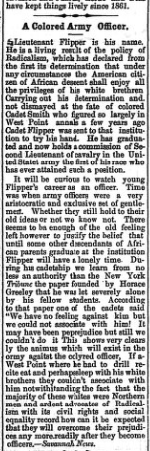
  • The Forest News

    June 20, 1877

    Published shortly after Flipper’s graduation, this article identifies him as the first African American to receive a commission as a U.S. Army officer through West Point. It captures contemporary reaction to the significance of his achievement.

  • Rome Weekly Courier

    July 4, 1877

    This report   celebrates Lieutenant Flipper’s historic graduation and commission in the   U.S. Cavalry. Its language also reveals the racial attitudes surrounding his   achievement and the broader debate over Black citizenship after   Reconstruction.

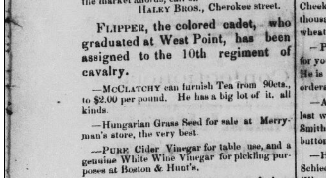
  • The Marietta Journal

    July 6, 1877

    A brief notice reporting that newly commissioned Lieutenant Henry O. Flipper had been assigned to the 10th U.S. Cavalry. The assignment marked the beginning of his service with one of the Army’s famed Buffalo Soldier regiments.

  • Weekly Chronicle & Constitutionalist

    July 11, 1877

    A detailed account of a New York reception honoring Flipper after his West Point graduation. The article records speeches, tributes, and the enthusiastic public recognition he received as the Academy’s first African American graduate.

  • Early County News

    July 13, 1877

    Reporting on   Flipper’s return to Atlanta after graduation, this article describes the   welcome he received in his hometown. It captures the pride surrounding his   achievement while preserving the period’s often complicated racial language.

  • The Clarion

    July 25, 1877

    Reprinting an Atlanta Constitution account, The Clarion describes Flipper’s return home after his historic West Point graduation. The article captures the excitement his arrival generated in Atlanta’s Black community and the public attention that followed him through the city.

  • Boston Post

    January 8, 1879

    A contemporary review   of Flipper’s 1878 autobiography, The Colored Cadet at West Point. The notice   shows that his account of life at the Academy entered public discussion   almost immediately after publication.

  • Boston Pilot (reprinted item)

    September 10, 1879

    A fellow 10th Cavalry officer describes Flipper as a capable, professional officer and defends the social respect shown to him. The article provides rare contemporary testimony about Flipper’s reputation within the Army and the racial environment in which he served.

  • Indianapolis Leader (letter dated Dec. 29)

    December 29, 1879

    In a letter from Fort Sill, Lieutenant Flipper writes to the Indianapolis Leader and purchases a subscription to the newspaper. This brief first-person document places him in active Army service and illustrates his connection to the Black press.

  • Sun-Journal

    August 23, 1881

    Published at the opening of the Fort Davis controversy, this report repeats serious allegations against Flipper before his court-martial. It is valuable evidence of the hostile public narrative already forming around his case.

  • New York Herald

    September 24, 1881

    Flipper publicly declares his innocence after being accused of embezzling government funds at Fort Davis. Drawing from a private letter, the article gives his detailed account of the missing funds, his arrest, and the actions of Colonel William Shafter.

  • National Republican

    September 27, 1881

    Published during the Fort Davis controversy, this article reports Flipper’s insistence that he was innocent of the charges against him. It captures his defense at a pivotal moment immediately preceding the court-martial that ended his Army career.

  • The People's Advocate

    October 1, 1881

    Published while the Fort Davis case was unfolding, this article presents Flipper’s own account of the accusations against him. In a private letter made public by his supporters, he describes Colonel William Shafter’s actions, the missing commissary funds, and his belief that a fair hearing would vindicate his character.

  • Savannah Morning News

    March 25, 1882

    This article cites Major General Benjamin Grierson’s strong assessment of Flipper’s Army service, praising his ability, integrity, gallantry, and performance on important duties. Although Grierson did not excuse the conduct leading to the court-martial, he argued that dismissal from the Army was too severe.

  • St. Joseph Herald

    June 21, 1882

    A brief War Department notice announces that Henry O. Flipper’s sentence would take effect on June 30, 1882, ending his service as an Army officer. The stark notice marks the formal conclusion of the military career he had begun with such promise only five years earlier.

  • Courier-Journal

    November 3, 1883

    After his dismissal from the Army, Flipper announces his intention to take his case before Congress. The article marks an early stage in the decades-long effort to challenge the circumstances surrounding his court-martial and restore his reputation.

  • Atlanta Journal

    June 3, 1885

    Flipper responds to accusations and defends his conduct several years after his dismissal from the Army. The article shows him actively contesting the public record while rebuilding his professional life outside military service.

  • Panama Gazette

    June 13, 1885

    This item looks back on Flipper’s West Point and Army history while noting his subsequent work in Mexico. It illustrates how his story continued to attract attention as he established a new career in engineering and the Southwest.

  • Wilkes-Barre Times Leader

    October 1, 1891

    This professional notice lists two technical papers involving Henry O. Flipper for a meeting of the American Institute of Mining Engineers, including one solely authored by him on coordinate surveying. It provides strong evidence of his established standing as a surveyor and mining engineer less than a decade after leaving the Army.

  • Santa Fe New Mexican

    October 12, 1893

    The Santa Fe New Mexican reports Flipper’s appointment as a special agent of the U.S. Department of Justice for the Court of Private Land Claims. The article highlights his expertise in surveying, Spanish translation, irrigation, and Mexican land law—skills that made him valuable to the federal government.

  • Chicago Chronicle

    June 13, 1897

    A later discussion of Lieutenant Flipper’s case revisits the circumstances surrounding his dismissal from the 10th Cavalry. The passage demonstrates that questions about the fairness of his treatment persisted well beyond the original court-martial.

  • The Oasis

    February 5, 1898

    An advertisement for Henry O. Flipper’s services as a U.S. Deputy Mineral Surveyor. It documents his successful reinvention as a civil and mining engineer working in the American Southwest after his military career.

  • Detroit News

    April 24, 1898

    A profile recalling Flipper as West Point’s first African American graduate while reviewing his later career. Though the supplied clipping is incomplete, it shows that his military milestone remained central to public accounts of his life.

  • The Colored American

    May 7, 1898

    This profile presents former Lieutenant Henry O. Flipper to readers decades after his West Point graduation. It connects his historic military achievement with the professional life he built after leaving the Army.

  • Leavenworth Times

    May 7, 1898

    This profile presents former Lieutenant Henry O. Flipper to readers decades after his West Point graduation. It connects his historic military achievement with the professional life he built after leaving the Army.

  • The Border Vidette

    April 13, 1907

    A brief professional notice identifying Flipper’s work as a civil and mining engineer. It provides evidence of the technical career he built in the Southwest long after his dismissal from military service.

  • El Paso Herald

    June 6, 1908

    Reporting on mining activity in Mexico, this article quotes Henry O. Flipper in his role as an experienced engineer and regional expert. It illustrates the substantial professional career he developed beyond his better-known West Point story.

  • Manchester Democrat

    November 4, 1908

    This article describes cliff dwellings in Chihuahua and identifies Flipper as an American archaeologist. It offers a striking example of the breadth of his work and interests during his years in Mexico and the Southwest.

  • The Afro-American

    April 1, 1916

    Published during the Punitive Expedition era, this article discusses African American troops entering Mexico and places their service within the longer history of Black soldiers. Flipper’s career forms part of that broader military legacy.

  • Chicago Defender

    August 26, 1916

    Written by a former member of the 10th Cavalry who said he knew Flipper, this Chicago Defender article argues that racial prejudice and Colonel Shafter’s actions helped destroy Flipper’s military career. More than three decades after the court-martial, it calls for his name and reputation to be restored.

  • Buffalo Times

    July 11, 1917

    Forty years after Flipper’s graduation, the Buffalo Times recalled his return to Atlanta as West Point’s first Black graduate. The brief anniversary item shows that his 1877 achievement remained part of public historical memory.

  • Chicago Defender

    March 6, 1921

    This chronology entry appears to document Flipper’s renewed federal service in 1921, but the exact March 6 source has not yet been verified against the surviving scan. It should remain flagged until the original article is matched.

  • New Journal and Guide

    March 19, 1921

    This report announces a new federal appointment for Henry O. Flipper and describes the positive response to his selection. It shows his continued public service and professional standing decades after his Army dismissal.

  • The Monitor

    April 21, 1921

    Calling Flipper 'Our First West Point Graduate,' this article celebrates a new appointment and revisits his pioneering military history. It connects his 1877 achievement with the respected government career he built afterward.

  • Colorado Statesman

    September 19, 1924

    The verified Colorado Statesman article reports a Senate effort to reinstate Flipper and place him on the retired list. It demonstrates that efforts to restore his military standing continued more than forty years after his dismissal.

  • Atlanta Daily World

    February 4, 1939

    A substantial retrospective introduces Atlanta readers to Flipper as a living resident of the city and recounts his West Point, Army, engineering, and government careers. The article preserves an important late-life account of how his achievements were remembered before his death.

  • Atlanta Daily World

    May 4, 1940

    Published after Flipper’s death at age 84, this obituary recounts his distinction as West Point’s first African American graduate and summarizes his later life. The coverage marks the transition of his story from living memory into historical legacy.

  • The Call

    January 3, 1941

    Published less than a year after Flipper’s death, this “Know Your History” feature revisited his pioneering West Point achievement, Army service, and later professional life, helping preserve his story for a new generation.

  • The Call

    July 4, 1952

    This extended “Know Your History” profile recounts Flipper’s journey from Thomasville and West Point through his military and civilian careers. Its appearance in 1952 reflects the continued posthumous recovery of his life and accomplishments.

  • Austin American

    March 24, 1963

    Historian J. Frank Dobie recalls Flipper’s work in the Southwest and a notable episode from his mining career. The article reflects the continued rediscovery of Flipper as an engineer, surveyor, and important figure in Western history.

  • Paris Post-Intelligencer

    July 10, 1970

    This historical feature revisits Henry Ossian Flipper’s life as part of a broader 'Daybook of America' series. Published nearly a century after his cadet years, it helped introduce a new generation to his pioneering place in West Point history.

  • Daily Breeze

    July 19, 1970

    This notice reports the issuance of a commemorative medal honoring Henry O. Flipper. The medal reflects the growing national effort during the 1970s to recover and publicly recognize his historical significance.

  • The News

    May 27, 1972

    A biographical feature recounting Flipper’s rise from Reconstruction-era Georgia to West Point and his later professional career. It is part of the twentieth-century rediscovery that helped move his story back into the national historical record.

  • Assembly

    June 1, 1973

    A review of John F. Marszalek Jr.’s Court-Martial: A Black Man in America revisits the Flipper case and the racial climate surrounding his years at West Point and in the Army. The article reflects renewed scholarly examination of whether he had been treated justly.

  • Kansas City Star

    December 6, 1975

    This retrospective emphasizes Flipper’s extraordinary post-Army career as a surveyor, engineer, translator, and public servant. It broadens his story beyond the court-martial and highlights the expertise that made him influential throughout the Southwest.

  • Houston Post

    April 15, 1976

    Focusing on Flipper’s work as an engineer and scholar, this article describes his role in untangling complex Southwestern land-grant issues. It demonstrates the depth of the professional career he built after leaving the Army.

  • Atlanta Constitution

    December 18, 1976

    Two days after news of the Army’s action, the Atlanta Constitution reported that Flipper’s 94-year fight for justice had ended with an honorable discharge. The article also documented the work of Ray MacColl and Congressman Dawson Mathis and examined the racial and procedural issues surrounding the original case.

  • Florida Times-Union

    January 21, 1977

    Thomasville leaders and Flipper relatives discuss relocating his remains to his Georgia birthplace. The article captures the growing movement to honor Flipper locally following the Army’s 1976 correction of his military record.

  • Assembly

    June 1, 1977

    Published during the centennial of Flipper’s 1877 graduation, this Assembly feature commemorates West Point’s first Black graduate. It also documents plans for the Henry O. Flipper Award and a permanent memorial at the Academy.

  • Florida Times-Union

    February 12, 1978

    This entry belongs to the period when Flipper’s restored reputation was being translated into public commemoration and institutional memory. The exact January 12 article should be matched to its scan before the website description is finalized.

  • Lima News

    December 17, 1978

    A nationally syndicated illustrated feature recounts Flipper’s life and pioneering achievement at West Point. Its appearance in 1978 reflects the expanding public recognition of his story during the years following his official vindication.

  • Assembly

    December 1, 1979

    While reporting the appointment of West Point’s first Black First Captain, this Assembly article looks back to Henry O. Flipper as the Academy’s first Black graduate. The comparison shows how his legacy had become part of West Point’s continuing story of African American achievement.

  • Assembly

    March 1, 1980

    A notice about cadet awards identifies the Henry O. Flipper Award and its purpose: recognizing leadership, self-discipline, and perseverance in the face of unusual difficulties. It documents the institutionalization of Flipper’s legacy at West Point.

  • Atlanta Voice

    April 13, 1984

    A powerful example of Flipper’s transition from historical figure to nationally commemorated American. Senator Mack Mattingly’s resolution sought to designate March 21, 1986 as “Henry Ossian Flipper Day,” while recounting Flipper’s West Point achievement, military service, 1976 record correction, and distinguished post-Army career.

  • Birmingham News

    February 25, 1994

    A 1994 reader campaign sought special recognition for Flipper and urged the U.S. Postal Service to issue a commemorative stamp in his honor. The letter summarizes his West Point achievement, Army service, post-Army career, and 1978 reinterment in Thomasville.

  • Seguin Gazette-Enterprise

    August 3, 1994

    This 1994 feature focuses on one of the least documented chapters of Flipper’s life: his years as a surveyor, engineer, and mining expert in Mexico and the Southwest. It is especially useful for showing how mystery and legend grew around his post-Army career, while also underscoring the need to separate documented history from speculation.

  • New Pittsburgh Courier

    March 6, 1999

    Published after President Bill Clinton’s 1999 action, this article reports the posthumous pardon of Henry O. Flipper 118 years after his court-martial. The pardon represented the culminating federal recognition of the injustice associated with his case.

  • New Pittsburgh Courier

    March 20, 1999

    In this commentary, Hugh B. Price reflects on the presidential pardon of Henry O. Flipper and the larger historical lessons of his case. The article places Flipper’s vindication within a national conversation about race, justice, and historical memory.

  • El Paso Times

    July 22, 1999

    This article reports the dedication of a Georgia post office bearing Henry O. Flipper’s name. The honor demonstrates how his restored reputation was being translated into permanent public commemoration in the years after his pardon.

  • Atlanta Constitution

    October 31, 2001

    By 2001, Flipper’s legacy had become an important part of Thomasville’s Black Heritage Trail. The Atlanta Constitution connects his birthplace, reinterment, presidential pardon, West Point memorials, and local commemorations—showing how Thomasville helped preserve and interpret his story.

  • Standard-Times

    February 25, 2002

    Fort Concho and San Angelo honored Flipper’s Buffalo Soldier service by officially unveiling Flipper Street in 2002. His grandnephew Joseph Flipper attended the ceremony, linking family memory with the growing public recognition of Flipper’s military and West Point legacy.

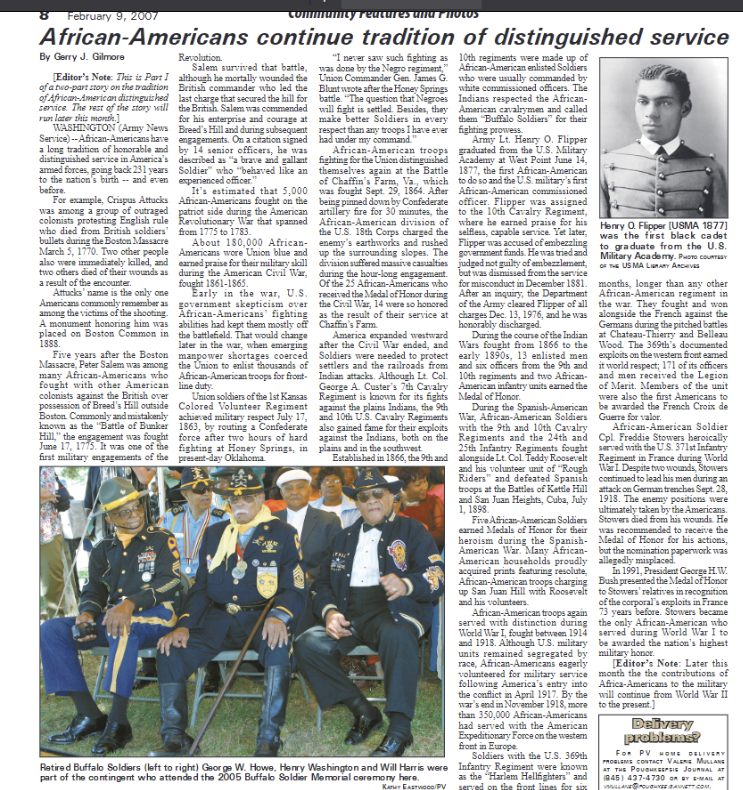
  • Pointer View

    February 9, 2007

    A 2007 Pointer View feature places Henry O. Flipper within the broader history of African-American military service, tracing his path from West Point’s first Black graduate to the 10th Cavalry and the eventual correction of his Army record.

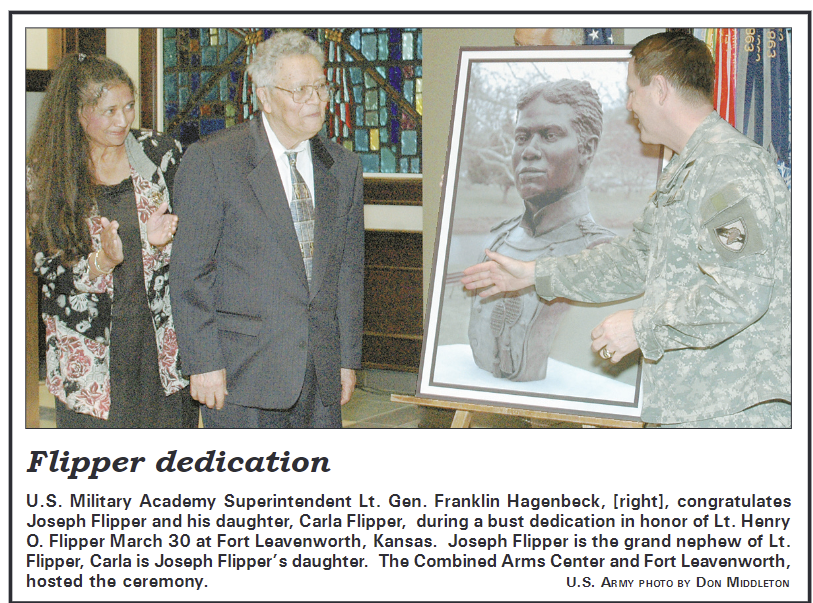
  • Pointer View

    April 6, 2007

    Fort Leavenworth honored Henry O. Flipper with a bust dedication in March 2007. His grandnephew Joseph Flipper and Joseph’s daughter Carla joined U.S. Military Academy Superintendent Lt. Gen. Franklin Hagenbeck for the ceremony.

  • Pointer View

    September 9, 2010

    At West Point’s 49th   annual Buffalo Soldier Ceremony, Henry O. Flipper’s legacy was remembered   alongside surviving Buffalo Soldiers. The article connects his 1877   graduation and 10th Cavalry service to the broader history honored at Buffalo   Soldier Field.

  • Pointer View

    February 17, 2011

    The 35th annual Flipper Dinner connected Henry O. Flipper’s experience to the Army values expected of future officers. Lt. Gen. Thomas P. Bostick emphasized Flipper’s perseverance, the correction of his military record, and the enduring leadership lessons of his life.

  • Pointer View

    September 8, 2011

    The 50th Buffalo Soldier recognition at West Point honored surviving veterans and the history of the 9th and 10th Cavalry. The article highlights Henry O. Flipper as a pivotal figure in that history and connects his legacy to generations of Black military service.

  • Pointer View

    September 4, 2014

    West Point’s 53rd Buffalo Soldier Ceremony celebrated a living military legacy. Pointer View again placed Henry O. Flipper at the center of that history, connecting his West Point achievement and 10th Cavalry service to the veterans honored at Buffalo Soldier Field.

  • Pointer View

    February 19, 2015

    The 2015 Flipper Dinner shows how West Point continues to translate Henry O. Flipper’s perseverance into a living standard for cadets. Doug Sprowl ’15 received the Flipper Award after overcoming significant adversity, linking his story to the values the Academy associates with Flipper’s legacy.

  • Pointer View

    February 25, 2016

    At the 2016 Flipper Dinner, Cadet Bridget Ryan received the Henry O. Flipper Award for leadership and perseverance through adversity. The event demonstrates how Flipper’s story continues to shape West Point’s understanding of resilience and character.

  • Pointer View

    February 16, 2017

    The 2017 Flipper Dinner brought national attention to Henry O. Flipper’s legacy when Vice President Mike Pence addressed the Corps of Cadets. Cadet Christopher “Lars” Lofgren received the Flipper Award, continuing the Academy tradition of honoring perseverance through adversity.

bottom of page